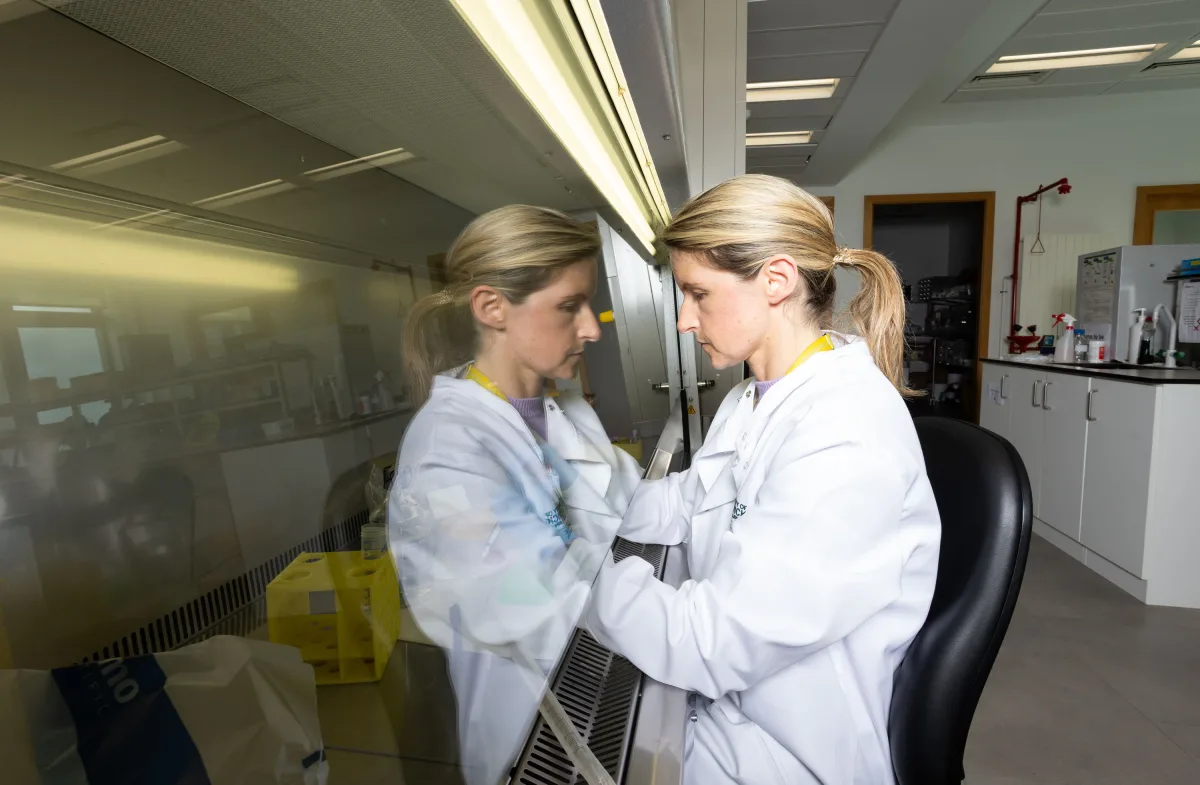
Our cancer research programme spans discovery science, clinical and translational research, digital innovation, integrated care and survivorship. Working with patients and the public, and with clinical, academic and research partners, we focus on research that can improve cancer care, outcomes and quality of life.
The Cancer Research Programme at Limerick Cancer Trials brings scientific innovation and clinical expertise together, creating an integrated research environment that connects academic discovery with clinical insight to improve outcomes for patients and families across the Mid West.
Research strategy
Four themes, one programme.
Our research strategy is organised around four interconnected themes, underpinned by education and training, Patient and Public Involvement, and collaboration.
Studies that fall under one or more of these four themes. They all involve recruiting patients but do not involve a therapeutic intervention.
Showing 15 of 15 studies.
Breast · 2
Themes: Major CancersDigital Innovation
Open to recruitment
AI led digital pathology
To investigate how artificial intelligence (AI) can be used to analyse breast cancer tissue samples and identify features that may help improve diagnosis, predict the risk of cancer recurrence, and support treatment decisions.
Who can participate
Patients with a diagnosis of breast cancer whose biopsy or surgical tissue samples have been collected as part of their routine care.
What’s involved
The study uses breast cancer tissue samples and clinical information already collected as part of routine care.
Principal investigators
Dr Máire Lavelle
Dr James Brown
Themes: Major Cancers
Open to recruitment
Breast Biobank
To establish a breast tissue biobank that will support future breast cancer research aimed at improving diagnosis, treatment, and outcomes for patients.
Who can participate
Patients undergoing breast cancer-related surgery.
What’s involved
Tissue that remains after routine surgery and is not needed for clinical care may be stored in the biobank for use in future ethically approved breast cancer research studies.
Principal investigators
Dr Máire Lavelle
Dr James Brown
Genito-urinary · 3
Themes: Major CancersIntegrated Care & Survivorship
Open to recruitment
Prostate Cohort
To understand the healthcare needs, wellbeing and quality of life of people living with prostate cancer, and to inform future services and support.
Who can participate
Adults with a diagnosis of prostate cancer who are medically fit to take part.
What’s involved
Participants will be asked to complete assessments and questionnaires about their health, wellbeing and care needs over time.
Principal investigators
Dr Niamh Peters
Prof Rose Galvin
Themes: Major CancersIntegrated Care & SurvivorshipCancer Inequalities & Social Deprivation
Open to recruitment
PROSTATE PLUS
To develop an evidence-based and patient-informed care pathway that addresses the unmet healthcare, support and wellbeing needs of older men living in rural areas with prostate cancer.
Who can participate
Men aged 65 years and older who are living in a rural or remote area and have experience of prostate cancer.
What’s involved
Participants will be invited to take part in a workshop to share their experiences of prostate cancer care and discuss areas where support could be improved.
Principal investigators
Dr Niamh Peters
Prof Rose Galvin
Dr Patrick O’Donnell
Themes: Major Cancers
Closed to recruitment
Cellular Mechanism of Urological cancers
To study blood and tissue samples from people with urological cancers to better understand cancer progression and treatment response.
Who can participate
People diagnosed with a urological cancer, such as prostate, bladder or kidney cancer.
What’s involved
Blood and/or tissue samples collected as part of a patient's care, together with relevant clinical information.
Principal investigators
Dr Niamh Peters
OMDr Olwyn Mahon
Haematology / lymphoma · 10
Themes: Major Cancers
Open to recruitment
HH Blood
To create a biobank of blood samples from people with hereditary haemochromatosis that can be used as healthy blood cell controls in future medical and scientific research.
Who can participate
Patients with hereditary hemochromatosis who are donating blood through their usual care or blood donation programme.
What’s involved
Participants will be asked to donate a small blood sample for research at the time of a routine blood donation or venesection appointment.
Principal investigator
Prof Ruth Clifford
Themes: Major Cancers
Open to recruitment
BCBI
To support blood cancer research by establishing a coordinated national biobank of blood and bone marrow samples, enabling researchers to better understand blood cancers, identify biomarkers, and accelerate the development of new diagnostics and treatments.
Who can participate
Newly diagnosed or relapsed blood cancer patients not on therapy.
What’s involved
Participants are asked to donate blood and bone marrow samples at the same time as routine clinical procedures.
Principal investigator
Prof Ruth Clifford
Multisite study
Themes: Major Cancers
Open to recruitment
MRD
To understand how genetic risk and measurable residual disease (MRD) influence treatment outcomes in people with newly diagnosed multiple myeloma undergoing a stem cell transplant, and to identify factors associated with longer-term disease control.
Who can participate
People with newly diagnosed multiple myeloma who are eligible for a stem cell transplant and receiving standard treatment as part of their usual care.
What’s involved
The study collects information from routine clinical care, including blood and bone marrow samples taken during scheduled hospital appointments.
Principal investigator
Prof Ruth Clifford
Multisite study
Themes: Major Cancers
Open to recruitment
Fantom 6
To understand the role of non-coding RNA molecules in chronic lymphocytic leukaemia (CLL) and how they influence the development and behaviour of cancer cells.
Who can participate
People with a confirmed diagnosis of chronic lymphocytic leukaemia (CLL) who have not yet started treatment
What’s involved
Participants will be asked to provide a blood sample for research.
Principal investigators
Prof Ruth Clifford
Dr Elizabeth Ryan
Multisite study · with RIKEN
Themes: Major Cancers
Open to recruitment
ctDNA in DLBCL
To investigate whether blood-based biomarkers, including circulating tumour DNA (ctDNA) and markers of the immune response, can help identify how people with diffuse large B-cell lymphoma (DLBCL) are responding to treatment and improve the early detection of high-risk disease.
Who can participate
Newly diagnosed patients with diffuse large B-cell lymphoma (DLBCL) who have not yet commenced treatment.
What’s involved
Participants will provide blood samples during routine appointments.
Principal investigators
Prof Ruth Clifford
Dr Elizabeth Ryan
Themes: Major CancersDigital Innovation
Open to recruitment
Ehealth Hub
To create a secure research database of clinical information from people with acute myeloid leukaemia (AML), chronic lymphocytic leukaemia (CLL) and multiple myeloma (MM) to support future blood cancer research and improve understanding of treatment outcomes.
Who can participate
Adults diagnosed with AML, CLL or multiple myeloma who have received care at University Hospital Limerick since 2020.
What’s involved
Researchers will collect information from participants' medical records, including details about diagnosis, treatment and outcomes. The information will be stored securely and used in approved research studies.
Principal investigators
Prof Aedín Culhane
Prof Ruth Clifford
Multisite study
Themes: Major Cancers
Open to recruitment
Immune Microbiome
To investigate how the immune system, gut microbiome and tumour genetics affect disease progression and treatment outcomes in Chronic Lymphocytic Leukaemia (CLL).
Who can participate
People with a diagnosis of chronic lymphocytic leukaemia (CLL).
What’s involved
Participants provide blood samples and clinical information as part of routine care.
Principal investigators
Prof Ruth Clifford
Dr Elizabeth Ryan
Themes: Major CancersIntegrated Care & Survivorship
Open to recruitment
PQI_CGQI
To better understand the experiences and support needs of people living with chronic lymphocytic leukaemia (CLL), their caregivers and healthcare professionals to help improve CLL care and services.
Who can participate
People living with chronic lymphocytic leukaemia (CLL), family caregivers, and healthcare professionals involved in their care.
What’s involved
Participants will be invited to take part in an interview to discuss their experiences of living with, caring for, or providing care for CLL.
Principal investigators
Prof Ruth Clifford
Prof Rose Galvin
Prof Pauline Meskell
Themes: Major CancersIntegrated Care & Survivorship
Closed to recruitment
CLL cohort
To understand the healthcare needs, wellbeing and quality of life of people living with Chronic Lymphocytic Leukaemia (CLL), and to inform future services and support.
Who can participate
Adults with a diagnosis of Chronic Lymphocytic Leukaemia (CLL) who are medically fit to take part.
What’s involved
Participants will be asked to complete assessments and questionnaires about their health, wellbeing and care needs over time.
Principal investigators
Prof Ruth Clifford
Prof Rose Galvin
Themes: Major Cancers
Closed to recruitment
BV-MCL
To better understand the characteristics and outcomes of blastic variant mantle cell lymphoma (BV-MCL) and inform future research.
Who can participate
People diagnosed with the blastic variant of mantle cell lymphoma (BV-MCL) who have received treatment in Ireland.
What’s involved
Researchers will review existing medical records and treatment information from people diagnosed with BV-MCL.
Principal investigator
Prof Ruth Clifford
Multisite study
Clinical-scientific subgroups
Clinical and scientific expertise, working together.
Working closely with our academic partner, the University of Limerick, our clinical-scientific subgroups connect clinical and scientific expertise across key areas of cancer research. Each group is jointly led by a clinical and academic lead, supporting the co-design of research priorities, interdisciplinary thinking and the translation of research into better diagnostics, treatments and quality of life.
Blood
Clinical lead
Prof Ruth Clifford
Consultant Haematologist & Professor of Haemato-oncology
Research interests: CLL and lymphoid malignancies, Blood cancer translational research, Clinical trials leadership
Scientific lead
Dr Aisling Ross
Assistant Professor in Biomedical Science
Research interests: Epstein-Barr virus, lymphoma, tumour microenvironment, apoptosis
Biobank
Clinical lead
Dr Máire Lavelle
Consultant Histopathologist, Breast
Research interests: Breast pathology, digital pathology, cancer diagnostics
Scientific lead
Dr Elizabeth Ryan
Associate Professor in Immunology
Research interests: Cancer immunology, gut microbiome, inflammation
GU/Prostate
Clinical lead
Dr Niamh Peters
Consultant Medical Oncologist, UHL
Research interests: Prostate cancer, cancer of unknown primary, survivorship and QoL
Scientific lead
Dr Eoghan Cunnane
Associate Professor in Biomedical Materials Engineering, UL
Research interests: Tissue characterisation, in vitro models, medical device design, regenerative medicine
Breast
Clinical lead
Prof Chwanrow Baban
Consultant General/Oncoplastic Breast Surgeon, UHL & Associate Professor in Surgery, UL
Research interests: Breast cancer, surgery, breast prosthesis
Scientific lead
Dr James Brown
Associate Professor in Cancer and Cell Biology, UL
Research interests: Breast cancer, biomarkers, oncobiology & molecular therapeutics
Colorectal
Clinical lead
Prof Christina Fleming
Consultant General and Colorectal Surgeon & Adjunct Clinical Associate Professor in Surgery, UL
Research interests: Colorectal cancer, early onset colorectal cancer, robotics, quality of life
Scientific lead
Dr Kieran McGourty
Associate Professor in Department of Chemical Sciences, UL
Research interests: Cell biology, stem cell niches, multiomics
Allied Health
Clinical lead
Prof Rose Galvin
Professor in Physiotherapy
Research interests: Ageing research, frailty, geriatric oncology, integrated care
Scientific lead
Dr Sarah Dillon
Associate Professor in the School of Allied Health
Research interests: Ageing research, underserved populations, cancer survivorship
Cancer Nursing
Clinical lead
Fidelma Hackett
Advanced Nurse Practitioner in Haematology
Research interests: Chronic lymphocytic leukaemia, lymphoma, survivorship, PPI
Scientific lead
Prof Pauline Meskell
Professor in the School of Nursing & Midwifery
Research interests: Cancer survivorship, ageing, living with chronic illness
Social Inclusion
Clinical lead
Mary Rohan
Cancer Key Worker
Research interests: Patient experience, care navigation, access to cancer services
Scientific lead
Dr Patrick O’Donnell
Inclusion Health General Practitioner & Associate Professor in the School of Medicine
Research interests: Health equity, marginalised communities, clinical trial access
Data Science
Clinical lead
Dr Aisling Nee
Consultant Haematologist
Research interests: Blood cancers, clinical data quality, data-driven cancer care
Scientific lead
Prof Aedín Culhane
Director of the Limerick Digital Cancer Research Centre and Professor of Cancer Genomics
Research interests: Cancer genomics, Bioinformatics, Multi-omics data integration
PPI Cancer Research
Clinical lead
Deirdre Hartigan
Research nurse and PPI coordinator
Research interests: Public and Patient Involvement, co-design of research, patient-centred research
PPI lead
John Lawler
Chair, PPI Limerick Cancer Research Steering Committee
Research interests: Research priorities, study design, patient-facing research communication
Education & Innovation
Clinical lead
Dr Hilary O’Leary
Consultant Haematologist & Clinical lead of Haematology service
Research interests: Diagnostics, Medical Education, Lymphoma Research
Scientific lead
Prof Leonard O’Sullivan
Professor of Architecture & Product Design
Research interests: User-centred design, medical devices, 3D printing
Have a research idea or interested in working with us?
Precision medicine, biomarkers, diagnostics and imaging
Digital innovation
AI, analytics, bioinformatics and real-world evidence
Clinical research
Clinical trials, translational research and real-world evaluation
Research spotlights
Research making a difference.
Explore examples of research from across our programme, showing how collaboration between patients, clinicians and researchers is helping improve cancer care, outcomes and quality of life.
Blood
CLL17
Led from UHL by Prof Ruth Clifford, CLL17 compared continuous treatment with newer fixed-duration therapies for previously untreated CLL. The study was published in the New England Journal of Medicine and supports a shift towards time-limited treatment that can reduce long-term treatment burden without compromising outcomes.
UHL received a Movember grant led by Dr Niamh Peters with UL collaborators Prof Rose Galvin and Dr Patrick O’Donnell. The project focuses on older men in rural areas, using evidence and patient input to understand barriers, design improved pathways, and pilot a model of care tailored to unmet needs.
Fidelma Hackett's research explores the experience of CLL from patient, caregiver, and practitioner perspectives. Supported by a strong PPI approach, the work will inform Ireland's first evidence-based, end-to-end survivorship care pathway for people living with CLL.
Our research is strengthened through collaboration at every level. Building on the clinical and scientific expertise within the Mid West, we work with partners across Ireland and internationally to share expertise, develop research, access wider networks and increase the scale and impact of our work.
Regional
Building research capacity in the Mid West
We bring together clinical and scientific investigators, researchers, patients and public partners, and regional collaborators to develop shared priorities and strengthen cancer research capacity across the Mid West.
National
Connecting expertise across Ireland
We collaborate with cancer centres, universities and research networks across Ireland to develop studies, share expertise and strengthen cancer research.
International
Connecting to global research
We work with clinical and academic research teams, cooperative groups and industry partners worldwide to contribute to multicentre research and bring new opportunities and innovation to the Mid West.
These partnerships allow research developed in the Mid West to contribute to wider national and international programmes, while bringing expertise, innovation and research opportunities back to our region.
How we support research
Cancer research with impact.
We support clinicians and researchers to develop, deliver and share high-quality cancer research, providing expertise, resources and guidance across the research pathway.
Research development
We support the development of research ideas into well-designed studies, including refining research questions, study design and identifying the clinical and scientific expertise needed to move a project forward.
Investigator-initiated studies
We support clinicians and researchers to develop and deliver investigator-initiated studies, from early study development and feasibility through to study set-up and delivery.
Patient and Public Involvement
We support researchers to involve people with lived experience throughout the research process, helping to shape research priorities and questions, study design, patient-facing information and how findings are shared.
Education and training
We support the development of research knowledge, skills and capacity across clinical and scientific teams through education, training and opportunities to engage in cancer research.
Research dissemination and impact
We support the publication, presentation and wider dissemination of research findings, helping ensure research reaches clinical, academic, patient and public audiences and contributes to wider knowledge and future cancer care.
Start a conversation.
Have a research idea or interested in working with us? Get in touch to discuss research collaboration, investigator-initiated studies, clinical trial feasibility or other opportunities to work together.